The Connected Tide Clock: the accuracy of harmonic computation
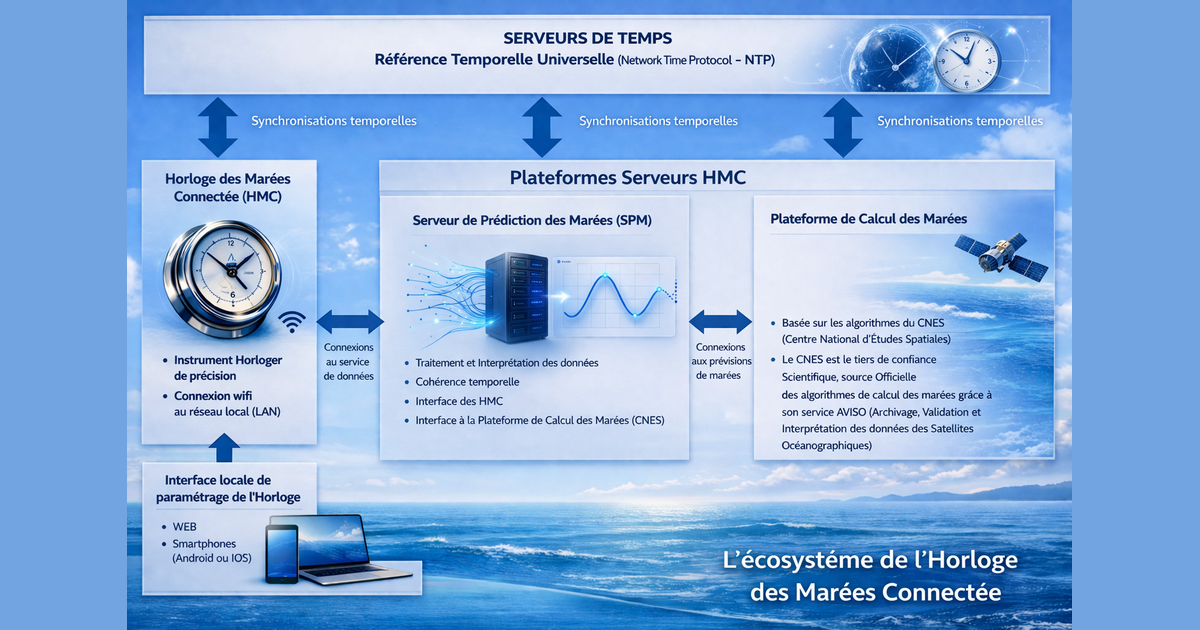
The Connected Tide Clock (HMC, for Horloge des Marées Connectée - the connected tide clock) is built on the mathematical models of CNES, the French national space agency and the official scientific reference for coastal oceanography. The tide is broken down into its periodic constituents - M2, S2, N2 and the rest - the very method the official hydrographic institutes use. The result is a prediction accurate to within minutes, port by port, over horizons of several years.
Permanently connected over Wi-Fi, the clock resynchronises itself on those models. Its accuracy does not decay with time: it is the reliability of a scientific measuring instrument, in the case of an analogue clock.
Why does this matter? Unlike a conventional mechanical tide clock - set once, then running at a fixed rate - the real tide shifts every day under the combined pull of the Moon, the Sun and the shape of the coast. Within a few weeks, the gap between an unconnected clock and the water can reach several hours. Only a connected instrument stays trustworthy over time.