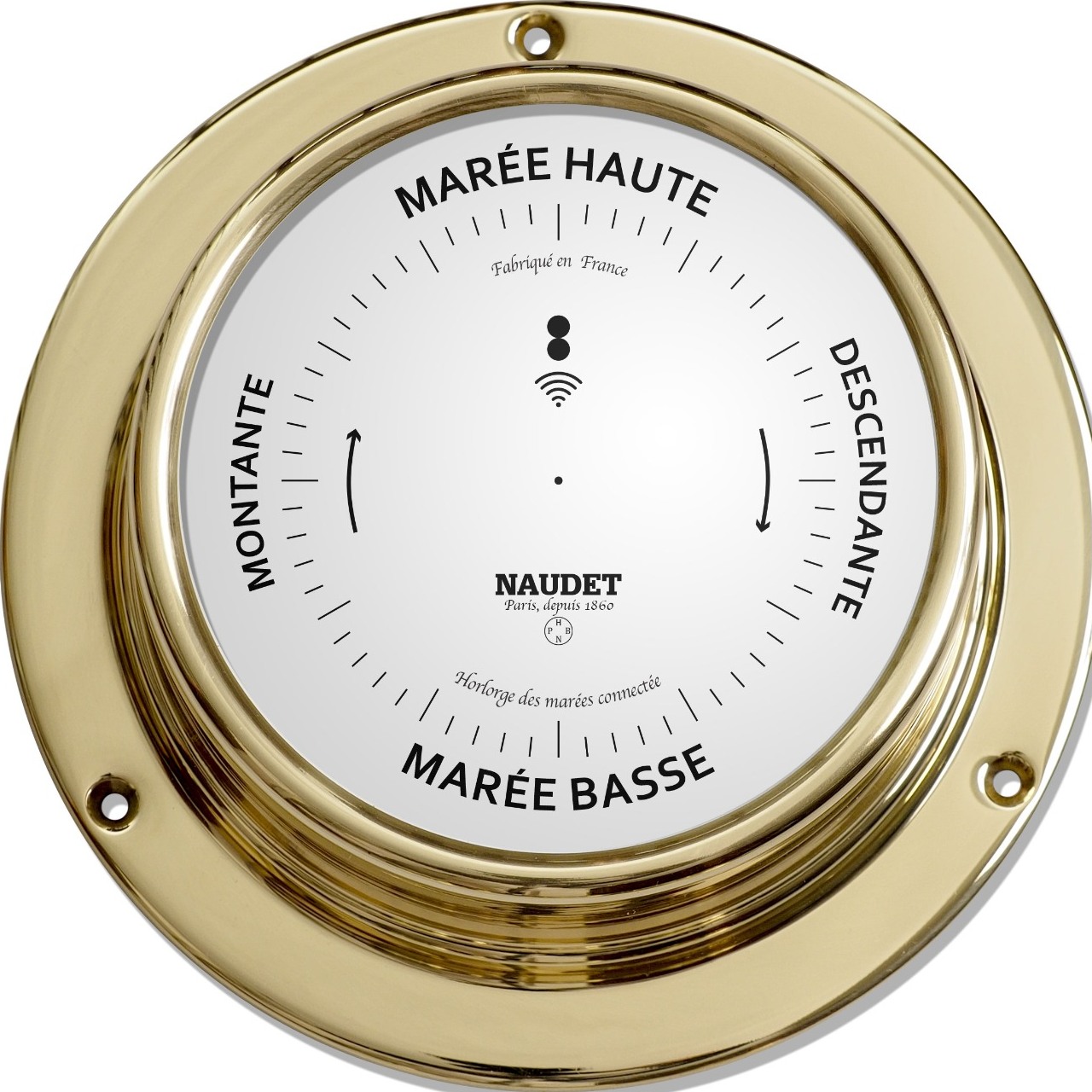
Connected Tide Clock™
The accuracy of an instrument, the elegance of a hand.
Your port, down to the hand.
An unconnected tide clock can drift by more than an hour a month. Ours never does.
A hand, your home port, and the accuracy of the CNES oceanographic models. The tide at a glance - no app, no screen.
1,031 ports across 7 countries, from the Azores to the US East Coast.
Port Le TréportIn partnership with Maison NAUDET, a French maker of measuring instruments since 1860.
Who it is for
Catch the right window: one glance is enough.
The state of the tide and the coefficient, read at once.
A big spring tide coming? The cockle beds will be worth the walk.
Sandcastles at low water, with the grandchildren.
Why connected? Because the tide is not a pendulum.
A traditional tide clock works like a mechanical watch: you set it once and it runs at a fixed rate. But the tide is not a pendulum. Its times shift every day under the combined pull of the Moon, the Sun and the shape of the coast - what operational oceanography calls the tidal harmonics.
The Connected Tide Clock solves that at the source. It uses the harmonic computation algorithms of CNES - the scientific reference in coastal oceanography - to work out, continuously, the exact position of the hand for your port.
Connected over Wi-Fi, it resynchronises on its own. The result: a reading as precise as a measuring instrument, in the case of an analogue clock.
Built to last: frugal with power, made for the people who live by the coast, for sailors and for fishers who want the tide at a glance.
And why a hand? Because a tide gauge measures the water level of the moment, and a row of LEDs only shows which step you are on. The hand answers the one question that matters on the coast: what time is the next tide. We check our predictions against the reference tide gauges, port by port.